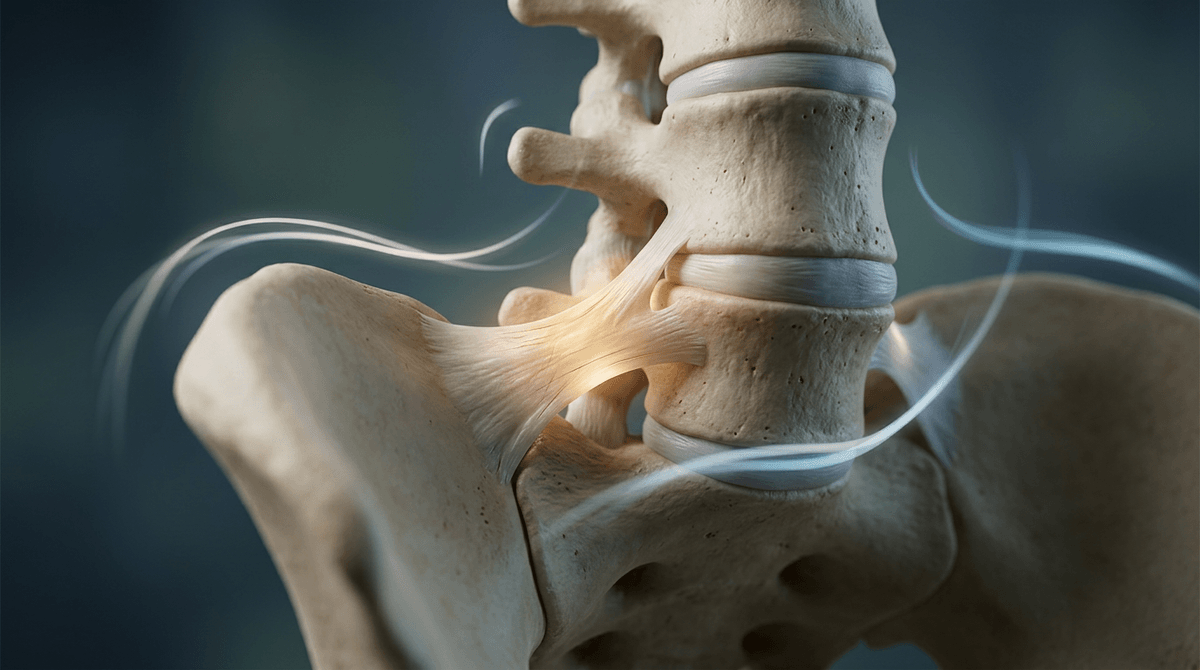
Sorting sprain pain from other back problems
It often starts with a tight, “caught” feeling when you try to stand up straight or roll over in bed, like your lower back is quietly refusing to cooperate. That can be unsettling because the pain may be sharp in one moment, then turn into a broad ache the next—especially after an awkward twist, lift, or slip that didn’t seem dramatic at the time.
With a sprain-type pattern, the discomfort is frequently tied to specific movements—bending, twisting, getting in and out of a car—more than to a steady, constant pain at rest. You might notice a tender spot along the low back or near the pelvis that feels “lit up” when you press on it, and a protective stiffness that shows up unevenly, like you can rotate one direction but not the other.
Part of the confusion is that the body can respond to a small tissue strain by bracing hard. That automatic guarding can make the area feel unstable or “out,” even when the bigger issue is irritation plus muscle protection changing how you move from hour to hour.
Pain signatures that point toward ligament irritation

You may notice the soreness has “edges”—it’s not everywhere, but it’s easy to find with your fingers. A spot along the bony rim of the pelvis or just off the spine can feel sharply tender to pressure, while the rest of the area feels more like a deep, guarded ache. That inconsistency can be confusing because it may feel worse to touch than it does when you’re sitting still.
The flare-ups also tend to track with small position changes rather than with steady effort. Rolling in bed, stepping out of a low car, reaching to one side, or a quick twist to grab something can create a sudden spike, then settle into stiffness again. In contrast, very gentle walking may feel a bit “rusty” at first and then slightly easier, even if you still feel protective tightness.
One reason this pattern shows up is that irritated ligament fibers have a lot of sensory input, so stretching or shearing them—often at end-range bending or rotation—can trigger a fast alarm. Your nervous system may answer that alarm by increasing muscle tone around the area, which temporarily limits motion. That bracing can make the pain feel unpredictable: it’s partly the irritated tissue, and partly the body’s attempt to keep you from moving into the positions it now interprets as risky.
What drives this pattern beneath the surface
After you’ve been up for a few minutes, you may notice you’re moving like you’re “carrying” the area—shorter steps, a quieter hip turn, a slight brace before you bend. It can feel inconsistent because it isn’t only the sore spot that’s deciding what hurts; it’s also the way your body is re-routing motion around it.
Ligaments don’t just hold things together—they also send a lot of position-and-threat signals to the nervous system. When a small cluster of fibers has been overstretched, local inflammation can make those sensors more reactive. A tiny amount of end-range shear (like the last bit of rotation when you reach or roll) may get interpreted as danger faster than you expect, even if the movement is light.
That “danger” message often leads to protective muscle guarding—higher resting tone in the low back, hip, and pelvic muscles—so the joints move less freely. Stiffness and altered timing can shift load to nearby tissues and make certain movements feel surprisingly sharp, then oddly better once the area warms up and the nervous system eases its grip.
Why recovery can feel nonlinear and confusing
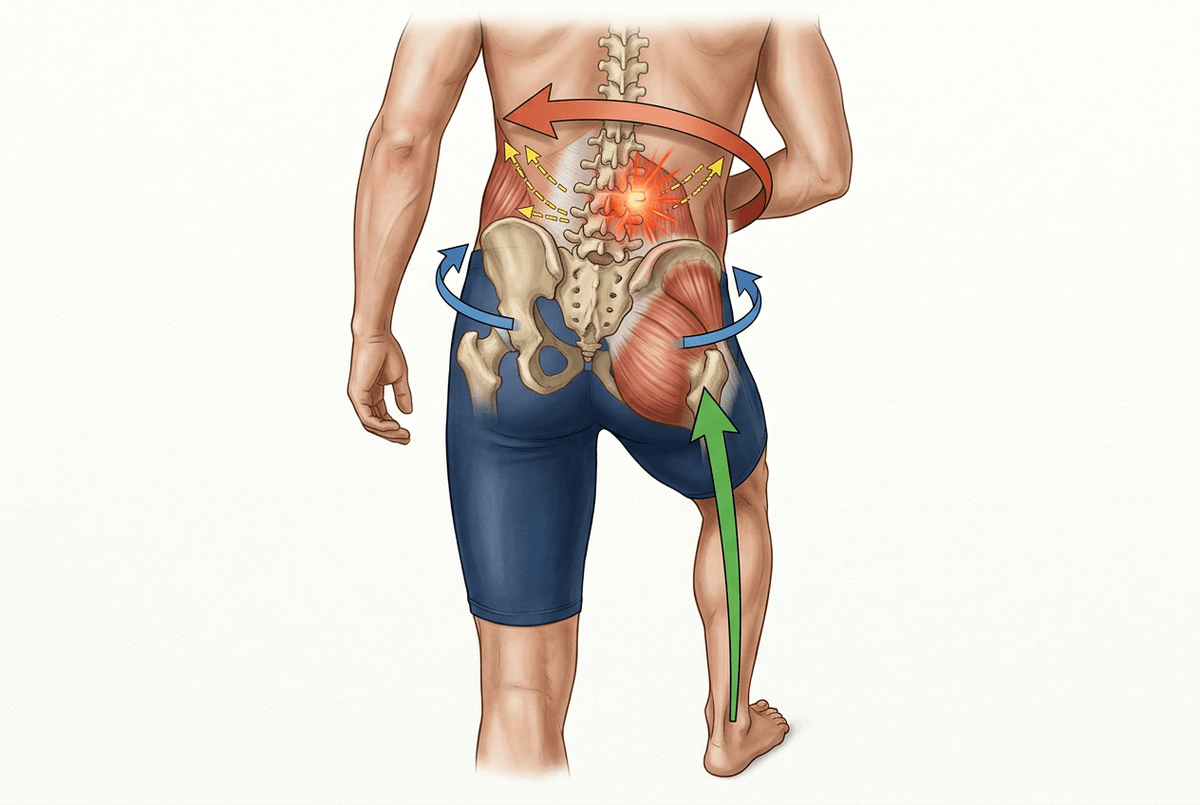
Some mornings you’ll stand up and think it’s finally loosening, then a simple reach into the back seat or a half-turn to grab a bag brings the same sharp “nope” as day one. That back-and-forth can make it feel like nothing is healing, even when the sore tissue is slowly settling in the background.
Part of the nonlinearity is that the irritated area is sensitive to how you move, not just how much you do. When a ligament has been overstretched, its threat signals can stay jumpy for a while, so end-range bending or rotation may still trigger a quick protective response. On a lower-stress day—better sleep, less sitting, fewer awkward angles—your nervous system may allow more motion. On a higher-stress day, the same movements can be met with more guarding, making the pain feel louder and the range of motion smaller.
You might brace without noticing, move through one hip more than the other, or avoid a turn and then “make it up” later with a bigger twist. Those little detours can unload the irritated spot for hours, then suddenly load it in a way it hasn’t tolerated yet, creating a flare that feels random even though the pattern has been building.
A reasonable move that can unexpectedly worsen pain
Later in the day, you might notice the ache feels louder right after you “did the responsible thing” and stayed very still—extra time on the couch, careful log-rolling, tightening your stomach before every step. It can be confusing because the rest feels protective in the moment, yet the first few moves afterward feel sharper and more cramped.
In some cases, that happens because stillness gives the guarding muscles more time to hold their grip, and your joints get less of the small, normal shifts that usually spread load around. Then when you finally bend, turn, or stand from low sitting, the motion you avoided has to show up all at once—often near end range—so the irritated area gets a sudden tug and your body answers with another spike of bracing.
If that pattern keeps repeating, the flare can start to feel “unpredictable,” even though it’s often tied to those stop-and-start stretches of protection.
Adjustments that support healing without overprotecting
By the time you get up after sitting, you may notice a split-second hesitation—like your back is waiting to see if you’ll “guard” before it lets you move. That’s often where people get stuck: they either clamp down and move like a statue, or they test the area with a sudden bend to see if it’s “better,” and both can feel like setbacks.
A more supportive pattern is usually smaller, steadier motion that stays away from the very last bit of range—especially combined bending and rotation that creates shear. The reason it can help is mechanical and neurological at the same time: ligaments that are still irritated can fire threat signals with end-range tugging, and your nervous system may respond by increasing muscle tone. When you move in a controlled, mid-range way, you’re giving the area load without the sharp “alarm,” so the bracing response is less likely to escalate.
In real life, this often looks like choosing positions that don’t force a deep hinge, breaking tasks into shorter bouts, and noticing when you’re holding your breath or tightening your trunk out of habit. If you can move more evenly through your hips and steps—even if it feels a little awkward at first—flare-ups may become less dramatic over a week or two, rather than disappearing all at once.
Red flags and checkpoints for getting assessed
The moment that tends to change the vibe is when the pain stops behaving like a “movement problem” and starts feeling uncontained—strong at rest, escalating fast, or spreading in a way you can’t map to a particular bend or twist. That shift can be easy to misread as “I just flared it,” even though it may be a sign you’re dealing with something beyond a simple irritated ligament-plus-guarding pattern.
It’s worth getting assessed sooner if you notice new numbness or weakness into a leg, pain that shoots below the knee and keeps intensifying, or trouble controlling bladder or bowel function. The reason these stand out is that they can reflect irritation or compression of structures that change nerve signaling, not just local tissue sensitivity—so the body’s usual protective stiffness isn’t the main driver anymore.
Other checkpoints are less dramatic but still important: unexplained fever, a history of cancer, recent infection, significant trauma, or pain that doesn’t ease at all over days and repeatedly wakes you at night. If you’re unsure where you fit, that uncertainty itself is a reasonable reason to check in—especially if your baseline is trending worse rather than slowly, inconsistently better.