What people expect versus what actually happens
It often starts with a small surprise: you lie down, the table feels firmer than expected, and your sore joint doesn’t love being held in one position. Some people walk in thinking it’s like a quick photo, then realize it’s more like a series of short “takes” where you have to stay steady even when you feel an itch, a muscle twitch, or that urge to adjust.
What’s actually happening is step-by-step. The scanner runs a sequence, pauses, then runs another, and each one “listens” for a signal pattern from your tissues. When you shift to get comfortable—or lift your head to check how long is left—the signal can smear across the image, which may look like blur or doubled edges. It can be confusing because the movement might feel tiny, but the machine is measuring very small differences.
The quiet parts can feel like you’re done, and the loud parts can feel like something is wrong. That stop-and-start rhythm is usually normal, even if it doesn’t match what you pictured.
How MRI builds images without using radiation
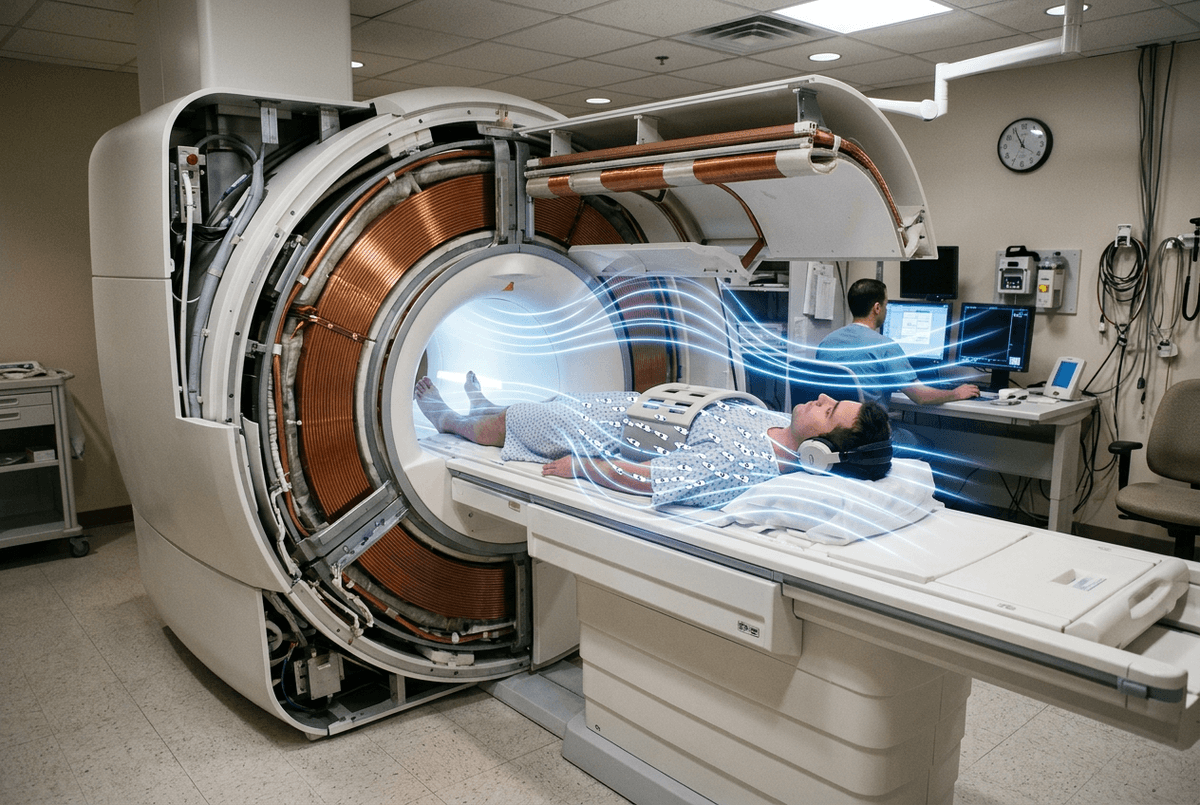
Halfway through the first few bursts of sound, it can be hard to believe anything is “happening” in there—especially when all you feel is the table under a sore back or joint, and a long wait you can’t see. That’s partly because the scanner isn’t taking a single picture. It’s running timed steps that build information line by line, even when the room feels still.
Inside the magnet, many of the hydrogen atoms in your body are nudged into a more organized state. Short radiofrequency pulses then tip that signal off-balance, and as it settles back, different tissues give off different amounts of signal at different speeds. Those differences are one reason fluid, muscle, fat, and cartilage can end up looking distinct—even when the pain feels like it’s all in the same place.
Gradient magnets add another layer by tagging where signals come from, so the machine can map them into an image. Because this process uses magnetism and radio waves—not ionizing radiation—it may feel counterintuitive if you’re expecting something like an X-ray, and that mismatch can make the stop-and-start rhythm feel more uncertain than it actually is.
Why stillness matters more than most realize
The longer you’re there, the more noticeable the little things become: a foot that wants to rotate outward, a shoulder that slowly creeps up toward your ear, a knee that starts to throb once the support pad compresses in one spot. It can feel inconsistent—comfortable at first, then suddenly not—and that’s often when people test a small adjustment, thinking it won’t matter.
But the scanner isn’t just “looking” once. Many sequences collect signal over seconds to minutes, and your body position becomes part of the measurement. When you move, the tissue the machine is sampling no longer matches the location it’s assigning that signal to, so edges can turn fuzzy or ghosted. With musculoskeletal scans, even subtle changes—like tightening a muscle against pain, swallowing hard, or re-centering your head—can shift alignment enough to create motion artifact that looks like blur rather than a clear tendon, cartilage surface, or nerve opening.
That’s why a technologist may stop, re-center you, and repeat a portion without much discussion. It can feel like you “did something wrong,” when it’s usually just the reality that discomfort and stillness compete, and the images only get as crisp as your position stays consistent.
Noise, tight spaces, and nervous-system reactions
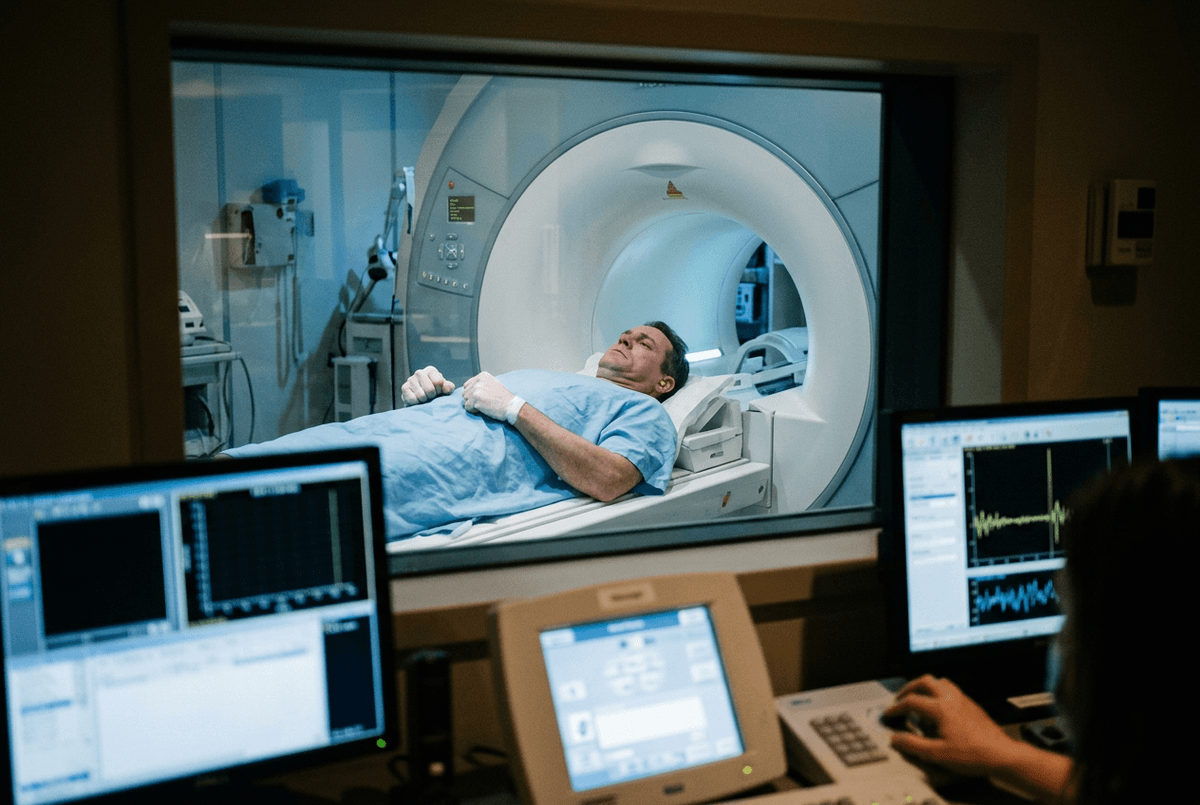
The first loud knock can make your chest jump even if you knew it was coming. In that moment, the tightness of the tube can feel suddenly “closer,” and people sometimes misread that shift as the scanner getting smaller, when it’s really their body registering threat and narrowing attention.
The sound isn’t just background noise. Those rapid clacks are the machine switching gradients on and off, and the pattern can trigger a startle response—your muscles tense, your breathing turns shallow, and your mind starts tracking time in an uneven way. When your nervous system moves into a fight-or-flight state, stillness can become more effortful, especially with a painful joint that already wants to guard.
In a narrow space, it’s also common to feel an urge to “check” with your head or shoulders, even if you stay mostly still. If the feeling keeps building, it may help to name it as a body reaction rather than a sign that something is going wrong, and let the next pause reset you a little.
Metal screening and the logic behind restrictions
It can feel a little picky when the technologist asks you to empty your pockets again, or when you’re sure your bra clasp or hairpins are “tiny enough” to ignore. In the moment—especially if your back is already aching on the table—those questions can read like rules for the sake of rules, and the extra checking can add to the sense that you’re being delayed for no clear reason.
But the magnet isn’t just “on” during the loud parts. It’s a strong, steady field the whole time, and metal can interact with it in a few different ways. Some items can be pulled or twisted, which is why certain objects are treated as a safety issue even if they seem small. Other metals don’t move much but can disturb the field locally, which may create a dark patch, warping, or missing detail right where a tendon, joint surface, or nerve opening needs to be sharp.
Even when something is “MRI-conditional,” the conditions matter—scanner strength, body region, and how long you’ll be in the field—and if the details aren’t clear, the safest choice may be to pause and confirm rather than guess.
Contrast dye questions: when gadolinium enters
Sometimes the first hint is procedural: partway through, the technologist’s voice comes on and you’re told there will be an injection. If you were bracing for a single, continuous scan, that mid-scan switch can feel like an unexpected fork in the plan, and it’s easy to assume it means something “worse” was found—even when it’s simply the way the exam was ordered.
Gadolinium contrast isn’t used for every musculoskeletal MRI. When it is used, the goal is usually to change how certain tissues handle signal so areas with more blood flow or “leakier” small vessels can stand out more clearly against nearby muscle, fat, or fluid. That can matter in specific questions—like evaluating inflammation patterns, post-surgical scarring versus recurrent issues, infection concerns, or certain masses—because those situations may look too similar without that signal shift.
You may not feel much beyond a brief IV pinch, so the “big change” is invisible to you while the scanner repeats some sequences in a new way. If you have kidney disease, a history of contrast reactions, or you’re unsure which type you’re getting, it’s worth saying so before the IV is placed, since the risk discussion depends on those details.
Preparation that reduces friction on scan day
On scan day, the smallest annoyances tend to feel bigger: a waistband that digs in once you’re flat, a zipper you forgot about, a sports bra clasp you can’t ignore when your shoulder has to stay neutral. People often assume “I’ll just deal with it,” and then realize that low-grade discomfort makes stillness take effort, especially once the sequences stack up and your body starts searching for a way out of the position.
What usually reduces friction is anything that prevents last-minute interruptions. Clothing without metal and fewer accessories mean less back-and-forth at screening, and having implant details (device card, surgery dates, the exact body part) can matter because “MRI-conditional” isn’t a blanket yes. If you use pain medicine or a calming medication, timing can be awkward—too early and it wears off, too late and you’re already tense—so it may help to clarify the plan with the ordering clinician ahead of time rather than deciding in the parking lot.
It can also help to treat the appointment like a fixed sequence: check-in, screening, positioning, then a set of repeated “takes.” When you expect pauses and repeats, it’s a little easier not to misread them as something going wrong—and to save your movement for the moments the technologist actually says it’s okay.