Why morning neck pain feels uniquely limiting
You notice it before you’re fully awake: turning your head to check the clock feels oddly difficult, like the movement has a “stop” built into it. It can be inconsistent, too—fine some mornings, tight on others—so it’s easy to blame a random pillow issue and move on.
Morning neck pain often feels more limiting because your neck has been held in one position for hours without the small, frequent resets you get during the day. When the head stays slightly rotated, tilted, or extended, some tissues stay shortened while others stay lengthened, and certain joints may take more pressure than they like. By the time you get up, the area can be more sensitive to normal motion, even if the original strain was low-level.
That “stuck” feeling can also make everything else harder. Looking down at a phone, backing up a car, or settling at a desk may suddenly feel like extra effort—partly because you start guarding without realizing it, moving your shoulders and upper back instead of your neck.
Sleep posture loads joints in awkward end-ranges
The clue is often how your neck feels in the first minute or two: you can look one way more easily than the other, or you feel a pinch at the base of the skull when you try to “find neutral.” That lopsidedness can be confusing because nothing dramatic happened overnight—just hours of being slightly off-center.
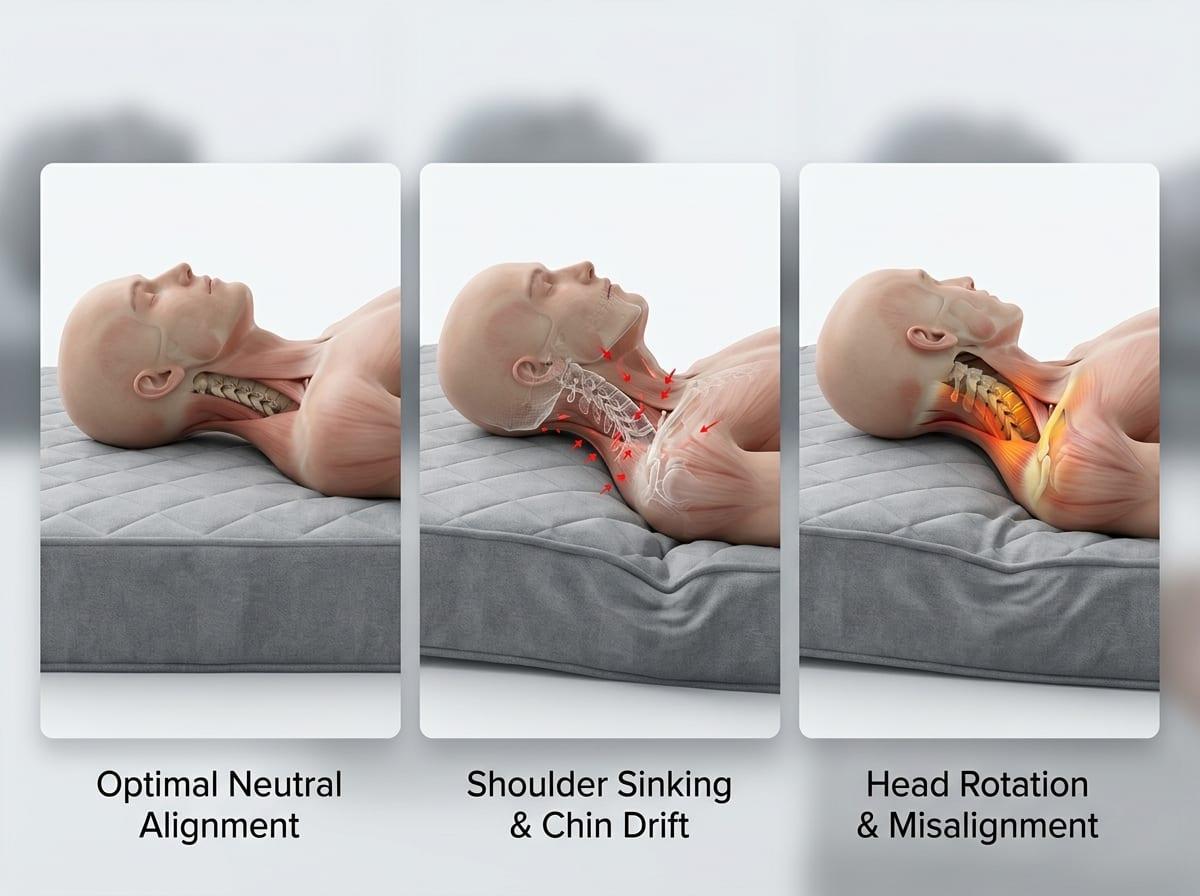
During sleep, small angles add up. A pillow that’s a little too tall can hold your neck in side-bend; one that’s too flat can let your head drop and leave tissues on one side stretched for hours. On your stomach, even a modest head turn becomes sustained end-range rotation, and the joints at the back of the neck may take more compression while other structures stay on a steady pull. It’s low-level loading, but it’s continuous, which is why it can feel disproportionate by morning.
What makes it inconsistent is that the “stack” changes night to night: how far your shoulder sinks into the mattress, whether your chin drifts up, which way your head ends up turned, even whether your arm is under the pillow pushing your head into extra tilt. If your day already involves a lot of downward gaze or one-sided shoulder tension, that same overnight position may cross your tolerance sooner, so the pattern can look random when it isn’t.
What drives overnight stiffness beneath the surface
Sometimes the first few swallows or deep breaths in the morning make it clearer: the front of the neck feels tight, and turning your head triggers a wary, protective pause. It can be strange when the soreness sits on one side, yet you can’t remember waking up or “doing anything” to it.
Under the surface, a big part of morning stiffness is the way tissues respond to being held still for hours. When muscles and the thin connective layers around them stay shortened or lengthened without breaks, they may temporarily lose their easy glide, and the nervous system can treat normal movement as a bigger change than it really is. In some cases, joints that were lightly compressed in rotation or extension become more reactive after long, uninterrupted pressure, so the first motions feel blocked even if the position was only slightly off.
That’s also why it often eases as you get moving. Gentle heat from a shower, walking around, and normal head turns increase blood flow and tissue temperature, and your brain updates its “safe range” as it gets fresh feedback. But if the stiffness takes wildly different amounts of time to loosen up from one morning to the next, it can hint that your overnight angles weren’t as consistent as you assumed.
Muscle guarding can outlast the original trigger
You may catch yourself bracing before you even test the sore side—jaw a little clenched, shoulder slightly lifted, head turning as one unit with your upper back. It can feel like the neck is still “on alert,” even after a hot shower or a few minutes of moving around, which is frustrating when the night’s position was the only obvious trigger.
This lingering tightness often has less to do with stuck tissues and more to do with protection. After hours of low-level strain, the nervous system may start treating certain angles as risky, so the small stabilizer muscles in the neck and the larger ones that tie into the shoulder and upper back stay partially switched on. That guarding can compress sensitive joints, limit glide between muscle layers, and make normal rotation feel sharp or blocked—especially if you keep “checking” the painful motion throughout the morning.
The original irritation may settle, but the guarding can hang around because it’s driven by expectation as much as structure. If it keeps reappearing on the same side, it’s often a sign your system has learned a pattern, not proof that something is getting progressively damaged.
Pillows, mattresses, and the neutral-neck problem
It’s often most noticeable when you try to settle your head and can’t find a position that feels “even”—like your chin is subtly tipped up, or one ear feels closer to the shoulder no matter how you adjust. That can lead to second-guessing the pillow, but the pillow is only one part of the stack.
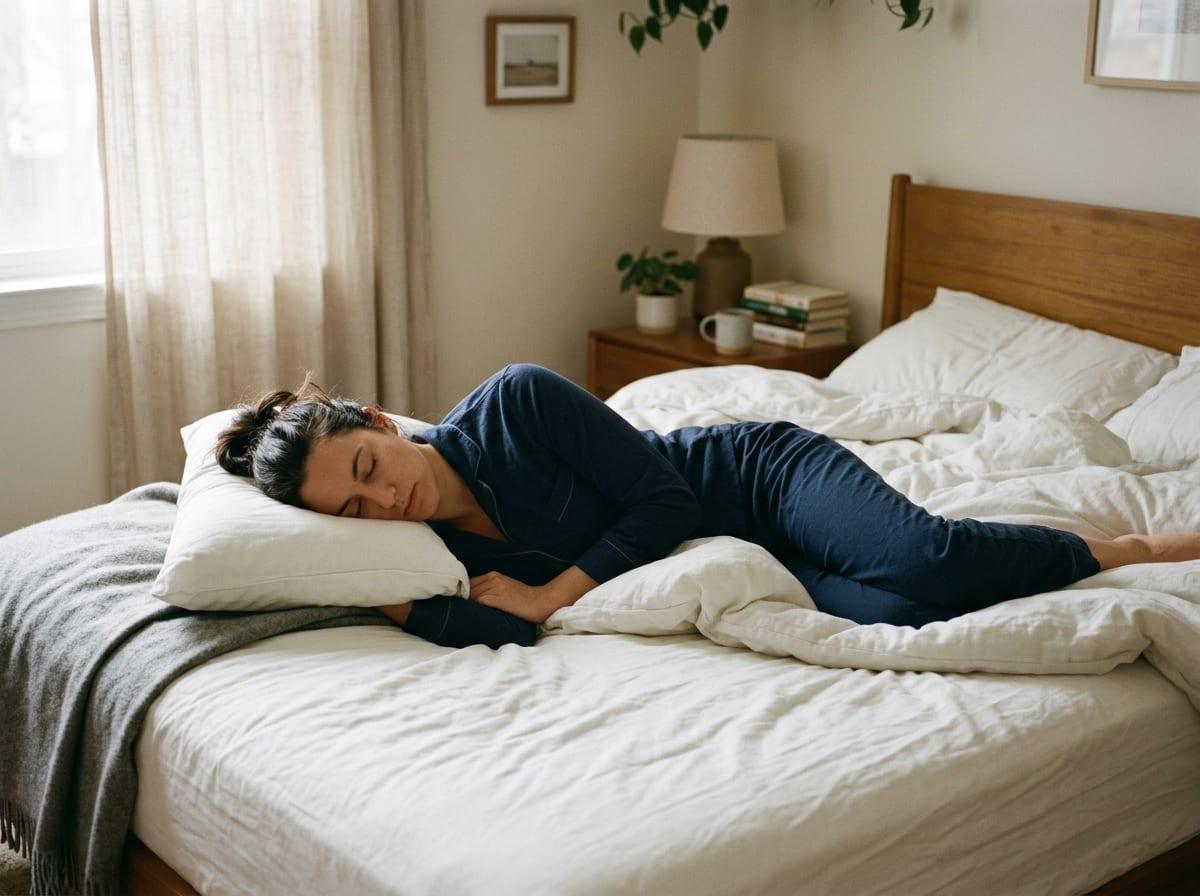
On your side, “neutral” usually depends on how far your shoulder sinks. If the mattress lets the shoulder drop a lot, a previously fine pillow can suddenly act too tall, holding the neck in side-bend for hours; if the surface is firm and you don’t sink much, that same pillow may be too low and let the head fall toward the mattress. With back sleeping, a pillow that props the head forward can keep the upper neck slightly flexed, while a pillow that encourages the chin to drift up can hold you in mild extension—both angles can be small, but long enough to matter.
Your body doesn’t feel these as “bad angles” at night. You’re asleep, so you don’t get the normal discomfort signals that would make you reset—then you wake up and interpret the soreness as a sudden injury, when it may simply be the consequence of a very steady, slightly off-center setup.
Relief methods that help—and ones that backfire
The morning after a stiff neck, it’s tempting to “test” it right away—turning farther and farther until you hit the sore edge. That push can feel productive, but in some cases it teaches your nervous system to keep treating that direction as a threat, which can prolong guarding even as the original irritation settles.
What tends to help more is anything that changes the input without demanding end-range motion. A warm shower, a heating pad for a short window, or simply getting up and walking can raise tissue temperature and blood flow so the first turns feel less abrupt. Keeping movements small and frequent—more like checking your blind spot halfway than cranking your head—often restores glide without triggering the “brace” response.
Some popular fixes can backfire because they add pressure or stretch to tissues that are already reactive. Aggressive neck stretching, forceful self-cracking, or long holds with the chin pushed far up or down can flare soreness later, even if it briefly feels looser. And bracing all day with a very stiff collar or “perfect posture” can trade pain for fatigue, because the muscles never get a chance to cycle on and off normally.
Red flags and when evaluation is worth it
Sometimes the worry shows up as a different kind of stiffness: not just “tight,” but pain that feels unfamiliar, unusually intense, or hard to calm down even as you move around. When that happens, it can be difficult to tell whether you’re dealing with the usual overnight sensitivity—or something that deserves a closer look.
Evaluation is more worth it when neck pain follows a fall or accident, keeps getting worse over days, or doesn’t start to ease with your normal morning routine. The same goes if you notice symptoms beyond the neck, like spreading numbness or tingling into an arm or hand, new weakness, severe headache, fever, or unexplained weight loss. Those patterns can suggest the issue isn’t just low-level mechanical loading from sleep, even if it started after a “normal” night.
And if the pain repeatedly wakes you from sleep or feels sharply different from your typical on-and-off stiffness, it may be a useful cue to stop guessing and get it checked—especially if your usual pillow or position changes no longer shift the pattern.