You feel it rising—before you try to ‘calm down’
It usually starts the same way: your chest tightens, your heart speeds up, and your attention snaps to one thought—something is wrong. You might still be typing, standing in line, or listening to someone talk, but part of you has already leaned toward escape.
The mistake is trying to “calm down” as if you can talk your body out of it. In a spike, arguing with the feeling often adds fuel. You also don’t have time for a perfect fix. You need a fast move that lowers the volume enough to keep functioning.
So the first job is simple: notice the rise and choose your kind of help—quiet or private—before your mind starts negotiating.
In the first 10 seconds: choose ‘quiet’ or ‘private’ (and don’t debate it)
That “negotiating” usually sounds like this: Should I push through? Should I leave? Will people notice? Those questions cost time, and time is what the spike uses to grow. In the first 10 seconds, pick one lane—quiet or private—based on where you are and what you can safely do right now.
Choose quiet if you have to stay put: you’re in a meeting, on a train, at a checkout, mid-conversation. Quiet means your moves look normal from the outside. You’ll use small actions that anchor attention without changing your posture much. Choose private if you can step away without creating a bigger problem: bathroom, stairwell, car, empty hallway, even turning your camera off for a minute. Private means you can breathe louder, tense and release muscles, or shake out energy without worrying about eyes on you.
Don’t debate the “best” option. Make a workable choice, commit for 60 seconds, then reassess.
If you’re in public: 4 grounding moves no one will notice
Quiet moments are when you need help that looks like normal behavior. You can’t close your eyes, you can’t pace, and you may have to keep listening or speaking. So pick one small anchor and run it for 30–60 seconds.
1) Foot pressure. Press your big toes into the floor, then your heels, like you’re checking your balance. 2) Finger count. Touch your thumb to each fingertip, one by one, and count backward from 10 in your head. 3) Name-and-locate. Silently label five things you can see, then where they are: “clock—left wall.” 4) Jaw drop. Let your tongue rest on the floor of your mouth and unclench your teeth; keep your lips together if needed.
In loud or crowded places, your attention will keep getting pulled away. That’s fine. Restart the same move each time, then decide if you can step away for a stronger reset.
If you can step away: reset the body with breath + muscle
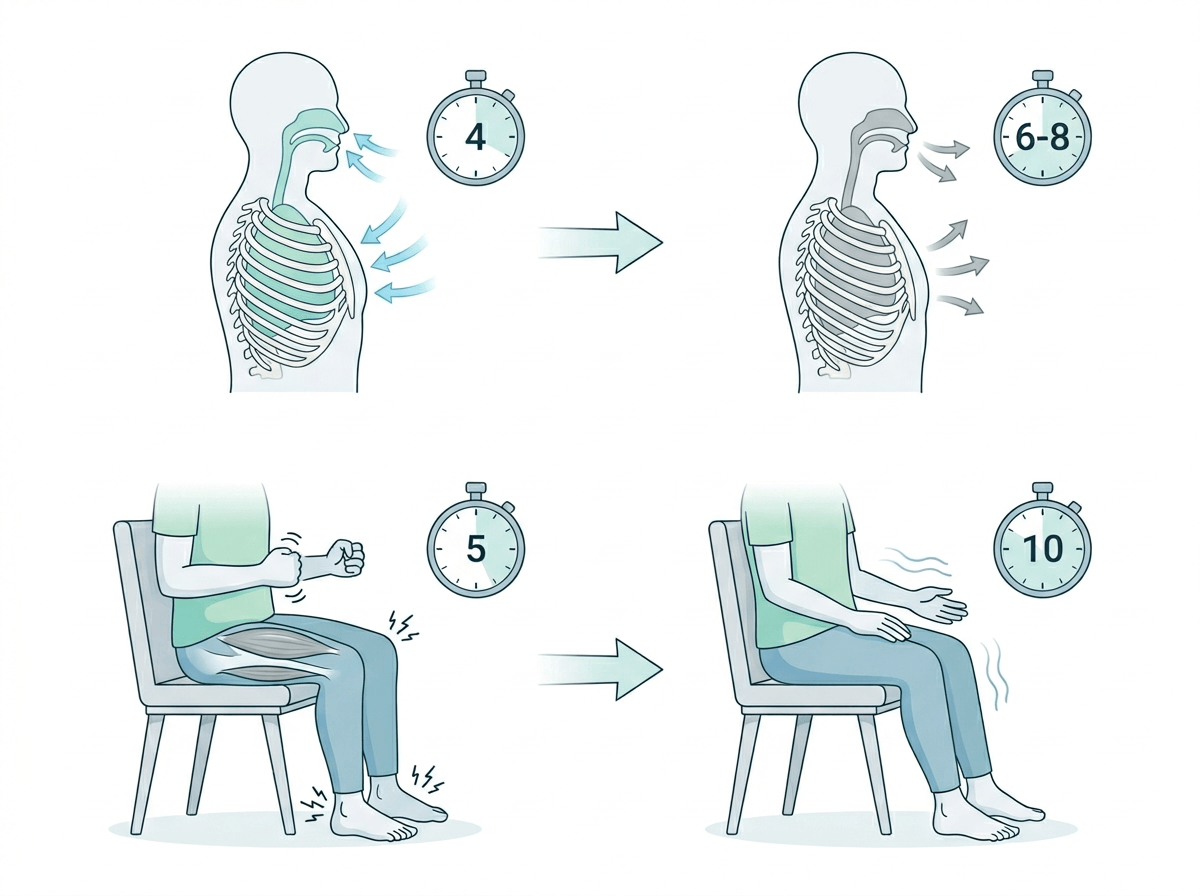
Stepping into a bathroom stall, a hallway, or your parked car is where you can do the “bigger” reset without performing for anyone. The goal isn’t to feel great. It’s to bring your body signals down fast enough that your mind has less to grab onto.
Start with breath: inhale through your nose for 4, exhale through your mouth for 6–8. Do five rounds. Keep the exhale longer than the inhale; that’s the lever. Then add muscle: press your feet into the floor and tighten your thighs and fists for 5 seconds, then fully release for 10. Repeat three times. If you feel shaky, shake out your hands for 10 seconds after the last release.
If you’re lightheaded, don’t force deep breaths. Keep them smaller and slower. When the surge dips even a little, your next move is to stop feeding the scary thoughts.
When the mind keeps shouting: quick mental anchors that interrupt doom thoughts
When the surge dips, the mind often fills the space with warnings: “What if I pass out?” “What if I say something weird?” “What if this never stops?” That’s not a sign you’re failing. It’s your attention looking for a new target. Give it a simple one that you can repeat.
Try a label + redirect: “doom story,” then immediately name three facts in front of you: “chair under me, feet on tile, cool air.” Or use a time box: “I’m only solving the next 60 seconds,” and pick one task you can do on autopilot—read one email line, stand still at the light, keep walking to the next door. If thoughts keep looping, switch to single sentence: “This is anxiety, not danger,” on every exhale for ten breaths.
After it dips: how to switch techniques and prevent the rebound

That “arguing back” is usually when you feel a small wave return—your heart bumps again, your stomach flips, and you think, “Here we go.” The rebound often happens because you drop everything the moment you get a little relief, then scan your body to check if it’s gone. That checking acts like a new alarm.
Switch on purpose. Keep your first technique for one more minute after you notice the dip, then step down to a lighter one that fits your setting: in public, stay with foot pressure or finger count while you do a normal task; in private, shift from long exhales to slow shoulder drops or a gentle thigh release. If a doom thought shows up, use one short line on the exhale and return to the task.
You might not get “calm,” just workable. When you can function again, lock in a tiny plan for what you’ll do next time.
Carry a tiny ‘grounding menu’ into tomorrow
That tiny plan works best when you don’t have to invent it mid-spike. Tonight or tomorrow morning, write a “grounding menu” with three lines: Quiet: foot pressure + finger count (60 seconds). Private: 4 in, 6–8 out (5 rounds) + tense/release (3 rounds). Mind: “This is anxiety, not danger” on every exhale (10 breaths). Put it where you’ll actually see it—phone notes, wallet card, the back of a badge.
In the moment, you’ll want to add options and “perfect” it. Don’t. A short list is usable when your brain is loud. Pick one item, run it, then return to the next small task in front of you.