You’re being told to “do more for mental health”—but what does that mean in a 2026 budget?
You’re staring at a 2026 benefits spreadsheet where every line item has a price tag, and “do more for mental health” shows up as a vague directive with no owner. The usual move—add an EAP reminder and a wellbeing app—rarely changes what employees feel on a Tuesday afternoon: too many tasks, unclear priorities, tense handoffs, and a manager who doesn’t have time to untangle it. That gap is where budgets get wasted and leaders get frustrated.
“More” has to mean something you can point to: fewer crisis escalations, faster access to care, better manager handling of conflict, or reduced overload in specific teams. The hard part is separating what’s actually showing up in your workforce from whatever is being marketed as a “2026 trend.”
Which “2026 trends” are actually showing up in your workforce right now?

In most mid-sized companies, the “trend” shows up as a pattern: more unplanned absences, more last-minute performance issues, and more managers asking HR what they’re allowed to say when someone is struggling. Hybrid work is still a factor, but not as an abstract debate—teams feel it as slower decisions, weaker handoffs, and employees who can go days without a real check-in. Add a tighter labor market in some roles and you get people holding two jobs’ worth of work without an obvious breaking point.
What’s real in 2026 is less about new diagnoses and more about three buckets you can observe: overload (work that doesn’t fit the week), conflict (tension that managers avoid until it blows up), and access (employees who can’t find timely care even when benefits exist). The constraint is that your data won’t neatly label these as “mental health.” If your only signal is EAP utilization, you’ll miss most of it—and you may buy another program that can’t touch the underlying load.
So start by asking where the strain concentrates: Which teams have the highest turnover, the most overtime, and the most employee relations noise? Then pressure-test any “2026 trend” against that reality, because when overload is the driver, better content won’t fix the week.
When overload is the real issue, programs won’t fix it
“Better content won’t fix the week” is what you learn the first time a team hits a deadline crunch and your shiny new benefit disappears under Slack pings. People don’t skip programs because they don’t care. They skip because the workday leaves no room: back-to-back meetings, constant rework, and priorities that change midstream.
If overload is the driver, the first lever isn’t a new vendor—it’s how work gets assigned and how decisions get made. Tighten intake so work doesn’t enter the system without a clear owner and due date. Put a cap on in-flight projects per person or per team, then make leaders pick what stops when something new comes in. Require “definition of done” on cross-team handoffs, because ambiguity creates late-night cleanup.
Saying no, slowing launches, and admitting capacity limits in front of senior leaders. If you can’t name one workload rule you’ll enforce, your mental health budget will keep paying to mop up after the same flood.
Managers are becoming the mental health system of record—ready or not
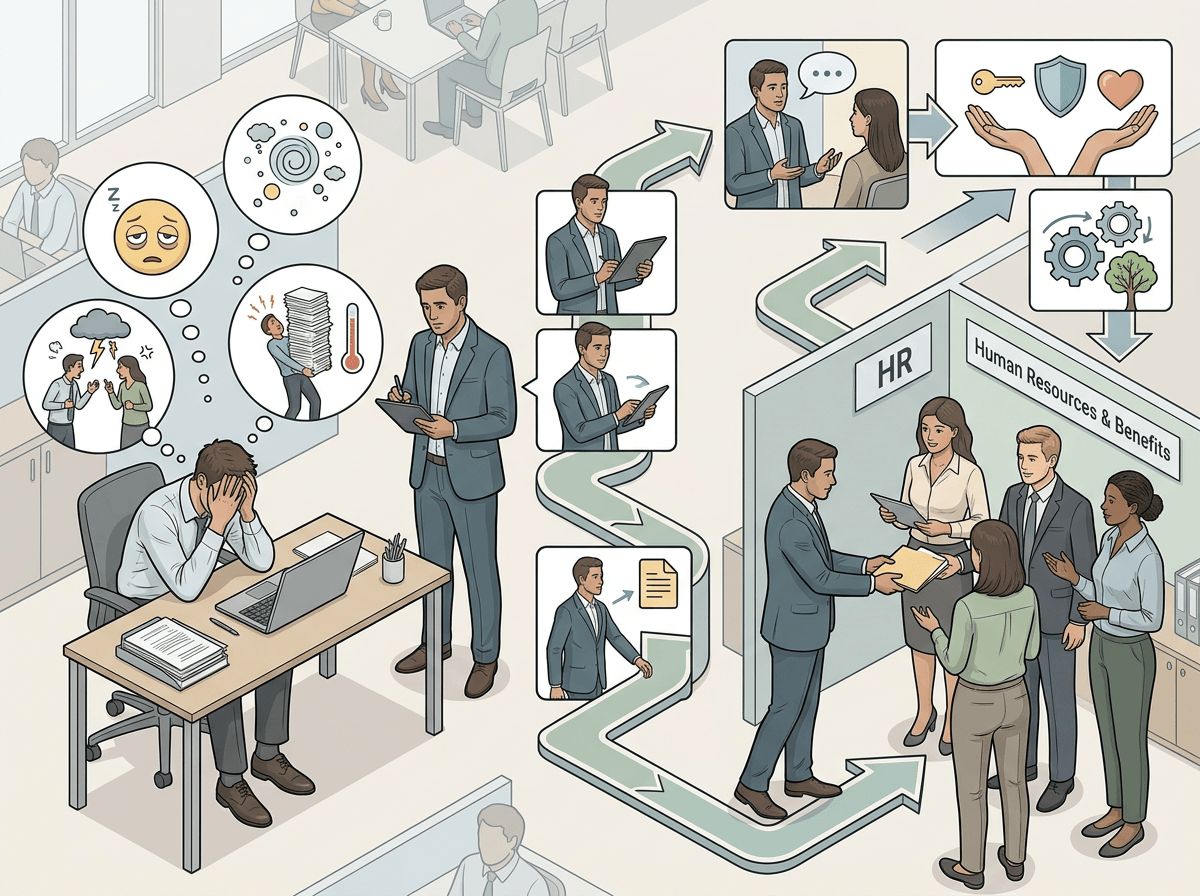
If you don’t name one workload rule you’ll enforce, it lands on managers instead—one “quick check-in” at a time. In a typical week, the first real signal of trouble isn’t an EAP call. It’s a missed deadline, an emotional blow-up in a 1:1, or a manager asking HR, “What am I allowed to say?” That’s how managers become the mental health system of record: they see the early warning signs, they hear the context, and they decide whether it turns into an absence, a complaint, or a quiet resignation.
That role is already here, but most managers weren’t hired or trained for it. If you expect them to carry it, spell out three things: what to notice (sleep, focus, conflict, workload), what to do (document work impact, reset priorities, route to HR/benefits), and what not to do (diagnose, promise confidentiality, keep private notes). The downside is time: even a basic escalation path adds minutes to every hard conversation.
Can a manager move an employee from “I’m not okay” to “here are the next two steps” in under 48 hours—without freelancing on risk, privacy, or policy?
Buying benefits in 2026: what replaces the ‘EAP + meditation app’ default?
Those “next two steps” break down fast when the only answer is “call the EAP” and “try the app.” In 2026, the better default is a tight care path: fast triage, real scheduling help, and a short list of options that match what employees actually need (therapy, psychiatry/meds, coaching, substance support, crisis). If employees have to hunt for an in-network provider at 10 p.m., you didn’t buy access—you bought a brochure.
Start by buying for the moments managers and HR see: conflict, overload, and “I can’t function this week.” That usually means a navigation layer with live support, guaranteed appointment windows (not just “as available”), and a way to route urgent cases without sending people through three portals. If you keep an EAP, treat it as one lane in the system, not the system.
Vendors will promise speed, but you’ll still hit limits in certain states, specialties, and languages, and your comms team will need repeated campaigns to get adoption. Before you sign, decide what data you will and won’t accept—because getting privacy and trust wrong will erase everything else.
The fastest way to kill adoption: getting privacy, data, and trust wrong
That “what data you will and won’t accept” question hits the moment an employee asks, “Will my manager see this?” If the honest answer sounds fuzzy, they won’t click. They’ll screenshot the privacy policy, ask a coworker, or skip the benefit entirely—especially in smaller teams where people already worry about being labeled “a problem.” Adoption doesn’t die from a bad poster. It dies from doubt.
In 2026, the common failure mode is treating mental health vendors like any other HR tool. If you ask for individual-level usage, session notes, or “high-risk employee lists,” you may get something you can’t safely store, explain, or defend. Even aggregated reporting can backfire when the cut is too small (“Engineering, Phoenix office, night shift”) and people can guess who used what. Set a floor for group reporting (for example, no slices under a minimum headcount) and keep identities out of your HRIS unless there’s a clear, written reason.
Before rollout, lock three things: a plain-English privacy promise employees can repeat, a data map that shows who sees what, and a manager script that never implies confidentiality they can’t provide. The cost is real time with Legal, Security, and the vendor—but it’s cheaper than buying access no one trusts, and it sets you up to measure progress without spooking the workforce.
From trends to a plan you can defend: your 2026 priorities and proof points
“Measure progress without spooking the workforce” is the bar for a plan you can defend: pick moves you can explain, fund, and track without collecting sensitive details you don’t need. Anchor 2026 on three priorities: one workload rule leaders will enforce (intake, WIP limits, decision rights), one manager standard (48-hour next-steps path with HR/benefits routing), and one access promise (triage plus scheduled care windows, not a directory).
Prove it with simple signals: overtime and backlog in the hot teams, ER cases tied to conflict, time-to-first-appointment, and repeat manager escalations. The hard part is that cleaner data means less detail—so you’ll need patience when executives ask for names.
Operate like this: if you can’t name the behavior that changes on Monday, don’t buy it on Friday.