Self-sabotage doesn’t feel like a choice—until you see the pattern
You sit down to start the thing that matters—send the proposal, book the workout, open the draft—and suddenly something else feels urgent. You “just” check email. You “quickly” research one more detail. You wait until you feel ready. Later, you’re rushing, apologizing, or quietly dropping the goal again, and it’s easy to call it laziness.
In the moment, it rarely feels like a decision. It feels like relief. That’s why willpower keeps losing to the same exits: procrastination, avoidance, and perfectionism.
The shift is to treat it like a repeatable sequence: situation → story in your head → body cue → escape move. Once you can spot that sequence, you can change what happens right before you derail.
Right before you derail: what’s going on in the moment you ‘should’ start?
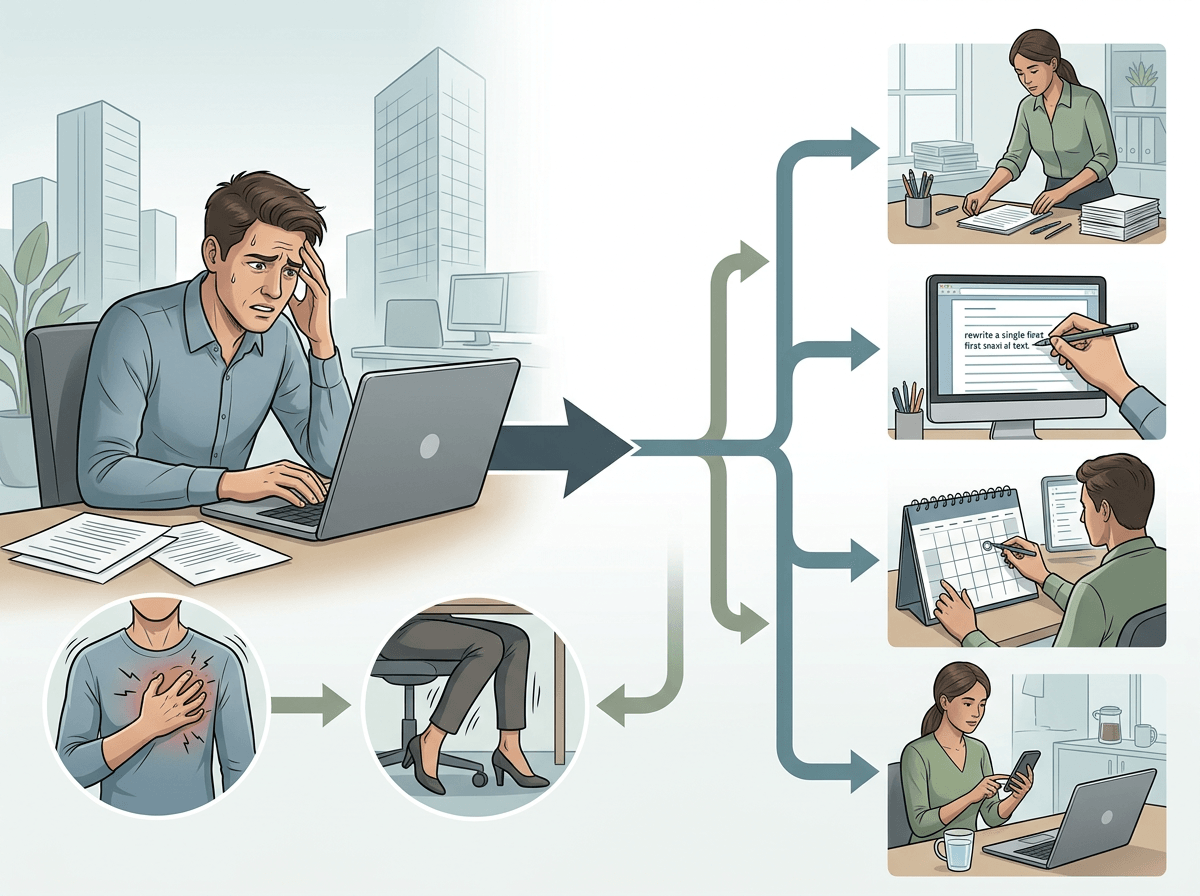
Right before you derail, it often looks like a reasonable pause. You open the laptop, pull up the file, and your mind jumps to what could go wrong: “I don’t have enough time,” “This isn’t the right angle,” “If I start, I’ll have to finish.” In seconds, the goal turns into a vague threat, and your brain reaches for something that lowers the pressure fast.
That’s the “story” part of the sequence doing its job: it explains the discomfort and offers an exit. Your body usually joins in—tight chest, restless legs, a buzz of urgency—then the escape move feels practical. You tidy the doc, rewrite the first sentence, schedule “later,” or pick a smaller task that lets you feel productive without feeling exposed.
Catch it earlier: the small signs you’re about to procrastinate, avoid, or perfect
Catching the earliest signals usually happens before you’re “flooded and staring at the whole project.” It’s when you hover. You open the file, then reread the same paragraph. You check the calendar “to be responsible.” You tell yourself you’ll start after one more coffee, one more tab, one more message.
Watch for micro-swaps that look harmless: changing fonts, making a cleaner outline, researching tools, or rewriting the first line again. If you feel a sudden need to organize, optimize, or get permission (“Let me ask one person”), that’s often the story trying to lower exposure. Your body will often flag it first—jaw tight, shallow breathing, a fast scroll, that itchy urge to do anything else.
These signs are quiet and easy to justify. If you wait for a big alarm, you’ll miss the moment you still have choice—right when you’re about to trade progress for relief.
Why this goal triggers you: choosing the most likely driver behind your loop

Right when you’re about to trade progress for relief, it helps to ask a simpler question than “What’s wrong with me?”: what does this goal threaten right now? Not in theory—in the exact moment you’re about to start. If the goal feels like exposure, your loop will lean toward perfectionism (“I need to get this right”). If it feels like loss of control, your loop will lean toward avoidance (“I’ll deal with this later”). If it feels like a test of worth, your loop will lean toward procrastination (“I’ll start when I’m in the right headspace”).
Pick the most likely driver by looking at your usual story. “If I submit this, they’ll judge me” points to fear of evaluation. “If I start, I’ll get stuck and waste the afternoon” points to fear of overwhelm. “If I choose this, I can’t choose everything else” points to fear of commitment. Don’t over-diagnose—choose one to work with for a week.
You won’t always feel the “real” reason clearly; stress makes your story noisy. That’s why the next move has to work even when you don’t trust your own explanations.
In the trigger moment, what do you do instead of escaping?
When the story gets noisy, you usually do what works fast: you flee into email, research, or “fixing” the first line. So make your replacement move just as concrete. Name the driver in five words—“fear of judgment,” “overwhelm,” “commitment”—then shrink the task until it’s hard to refuse: open the doc and add three bullets, write a bad first paragraph, or do a two-minute warm-up in workout clothes. The goal is movement, not quality.
Next, add a script that blocks debate: “I’m allowed to do this badly for 10 minutes.” Set a timer, and decide the exit in advance: when it rings, you either do another 10 or stop on purpose and write the next tiny step at the top of the file.
This can feel childish when the stakes are high, and some days you’ll still bolt. That’s useful data. If the smallest step still spikes you, you’ll need support and constraints, not more self-talk.
When willpower keeps losing: setting up support and constraints that actually stick
If the smallest step still spikes you, your environment is probably set up to make escape the easiest option. A familiar scene: you plan to write, but Slack is open, your phone is face-up, and your calendar has no protected block. In that setup, the “relief move” wins because it’s one click away and socially rewarded.
So shift from “try harder” to “make it harder to bail.” Put the doc in full screen, block the sites you flee into for the next 30 minutes, and leave your phone in another room. Pre-commit with a visible constraint: a coworking session, a body-double on Zoom, or a standing meeting where you have to show the draft. Use accountability that fits the task—someone who expects a screenshot of three bullets, not a perfect deliverable.
This is not free. Blocking tools break, schedules slip, and relying on other people can feel exposing. Start small: one protected block, one constraint, one check-in. Then watch what you still do to escape, because that points to what needs redesign in the next experiment.
If it still won’t budge: a one-week experiment—and when to get outside help
When you still find a way to escape, treat it like a one-week test instead of a character flaw. Pick one goal and one daily “start ritual”: same time, same place, timer for 10 minutes, and one tiny deliverable (three bullets, one ugly paragraph, shoes on and outside). Track three things on a note: the story, the body cue, and the escape move you tried to do. The point is pattern clarity, not a perfect streak.
If you can’t start even with a tiny step and real constraints, or the cycle comes with panic, shutdown, bingeing, or heavy drinking, bring in outside help. A therapist, coach, or physician can spot anxiety, ADHD, depression, or burnout—and help you build supports you can’t set up alone.